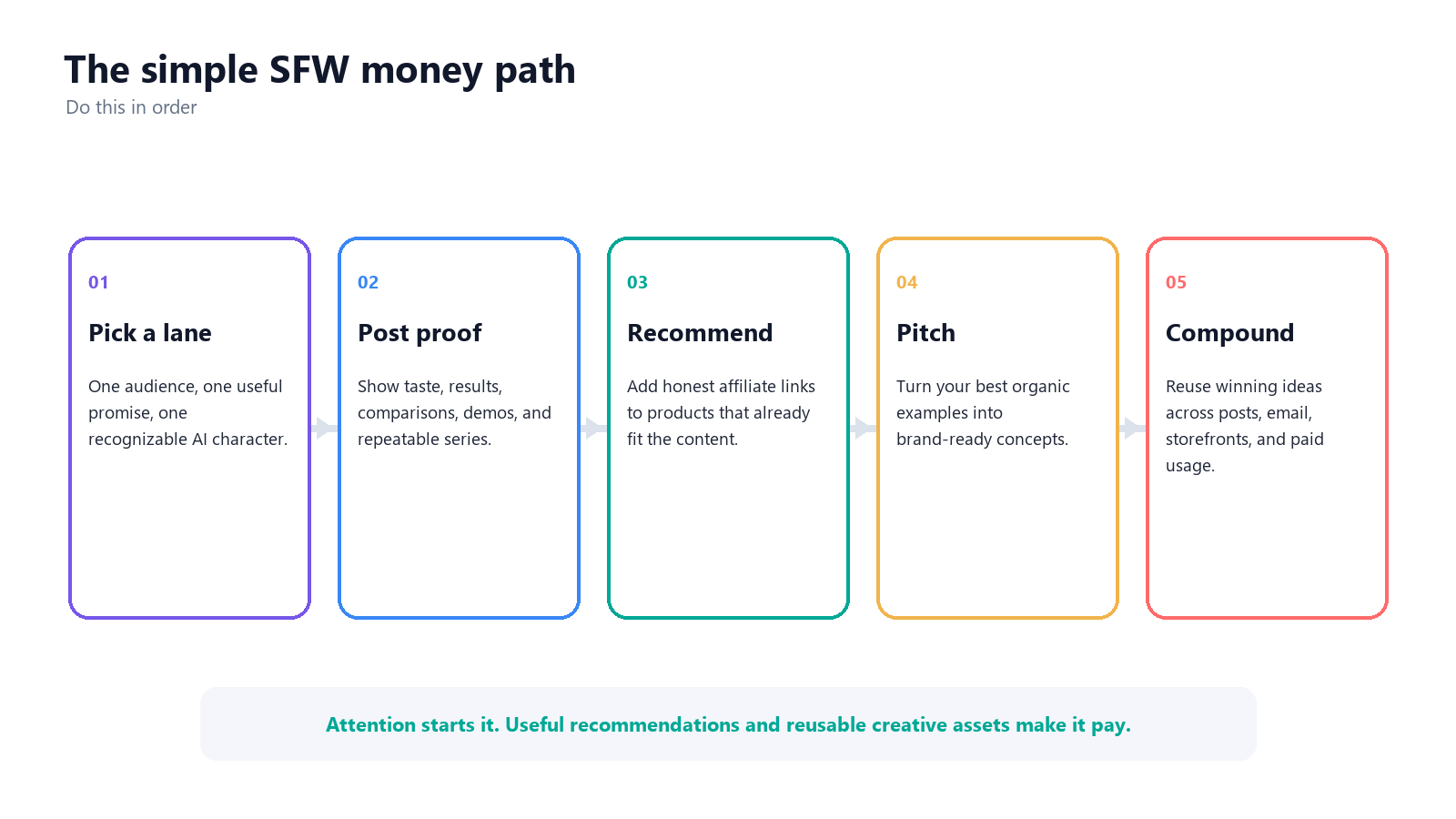
An AI influencer does not need a million followers—or a suspiciously perfect face—to make money. It needs a clear point of view, an audience with real buying decisions, and a content system you can repeat without turning the account into an endless ad.
Start with useful content. Add affiliate links to products that already fit. Use the results as proof when you pitch brands. Beauty may earn the first glance; usefulness and consistency earn the business.
What actually makes an AI influencer monetizable?
The strongest virtual creators are not generic models. They are recognizable characters with taste, constraints, and a reason to exist. “AI fashion girl” is forgettable. “A virtual thrifter who rebuilds celebrity looks for under $100” instantly suggests an audience, recurring posts, relevant products, and potential sponsors.
A workable creator idea has four parts:
- A person: a character you can describe in one sentence.
- An audience: people with a recurring problem, desire, or identity.
- A repeatable series: an idea you could produce 30 times without forcing it.
- A buying bridge: products and services the audience already uses.
| Weak starting idea | Stronger version | Natural offers |
|---|---|---|
| AI fashion model | A virtual stylist rebuilding premium outfits for normal budgets | Clothes, shoes, accessories, resale apps |
| AI fitness model | A mobility coach for desk workers with ten-minute routines | Bands, mats, apps, ergonomic gear |
| AI tech creator | A tiny-apartment gadget tester who hates clutter | Storage, smart-home gear, lighting, desk tech |
| AI beauty creator | A sensitive-skin ingredient translator | Skincare, tools, sunscreen, beauty retailers |
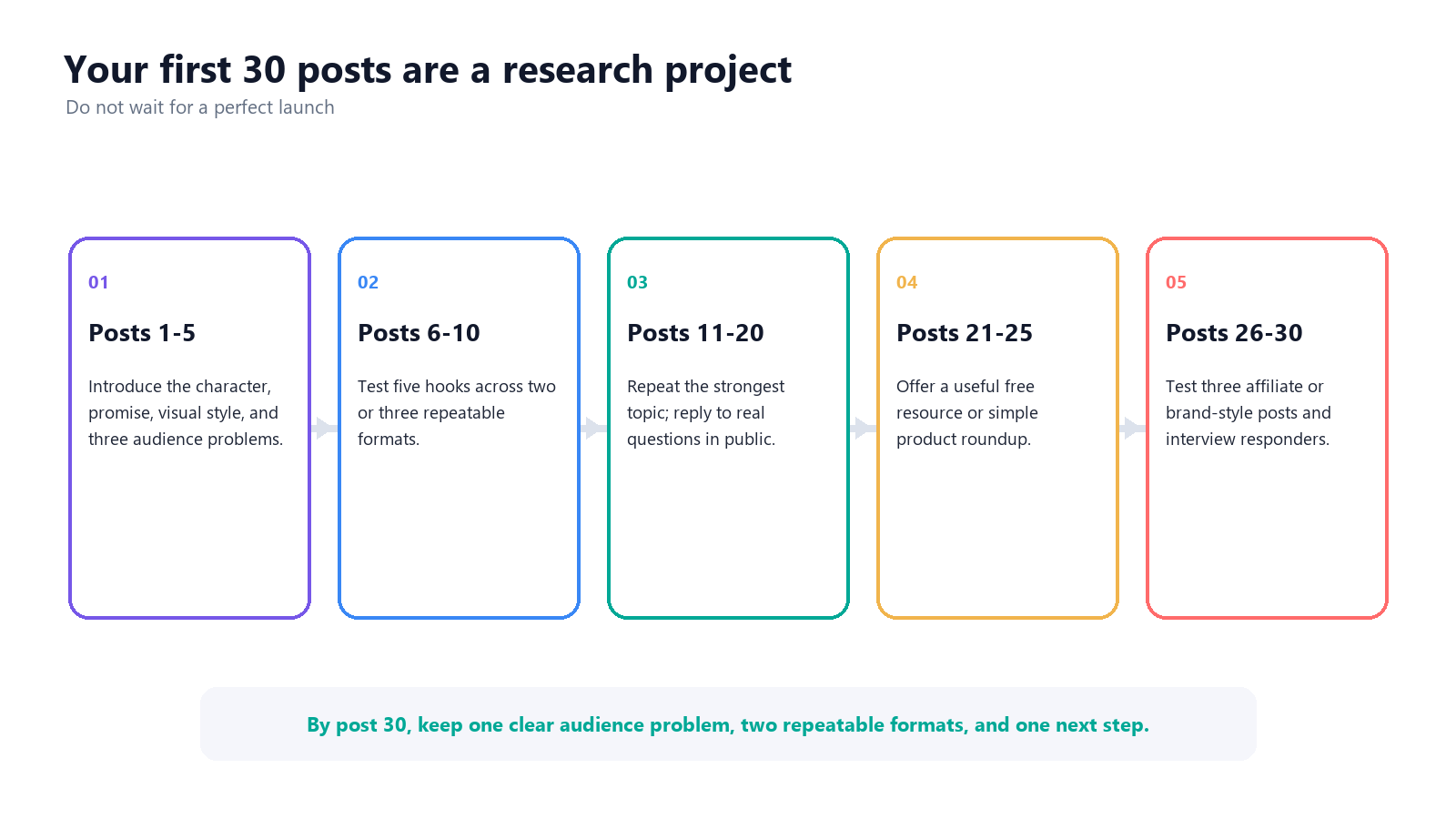
Starting from zero: your first 30 posts
A new account has no useful data. Your first month is a research project, not a grand launch. The job is to discover which combination of topic, format, and character earns attention from the right people.
Introduce the promise, visual identity, recurring setting, and one unmistakable opinion.
Try a comparison, tutorial, transformation, short story, and direct-to-camera explanation.
Make variations of the two posts that produced the best watch time, saves, profile visits, or useful comments.
Add a soft affiliate recommendation, one brand-style concept, and a useful free resource or email signup.
Set up the account before post one
- Claim the same readable handle on your primary platform, a backup platform, and an email address or domain.
- Use a profile image that still reads clearly as a tiny circle.
- Write a one-line bio: who the account helps + what it helps them do + the signature angle.
- Say plainly that the character is virtual or AI-operated. Hiding it creates a trust problem you eventually have to unwind.
- Create a simple link page with your current recommendations, email signup, and business contact.
- Pin three posts: Start Here, Best Example, and Who Runs This Character.
How often should you post?
For the first two weeks, publish one strong short-form post per day on your primary platform. Adapt the best three to five posts for a secondary platform. Use Stories or community posts on publishing days, then add one deeper weekly piece once the winning subject becomes obvious.
Do not let a generic “best time to post” chart run the account. Test morning, lunch or afternoon, and evening in the audience’s local time. Keep the windows that create watch time, saves, profile visits, and clicks—not merely impressions.
The content mix that does not feel like an ad
If every post recommends a product, the character becomes a catalogue. A better weekly mix alternates discovery, usefulness, personality, and commerce.
- Two discovery posts: a sharp opinion, trend adaptation, surprising comparison, or visual transformation.
- Two useful posts: tutorial, product breakdown, experiment, checklist, or before-and-after.
- Two relationship posts: character story, recurring ritual, behind the scenes, or a response to a real comment.
- One conversion post: recommendation, roundup, demo, waitlist, affiliate offer, or brand-style concept.

AI lets you produce more content. That is not permission to publish more filler. Every post should contain a decision, observation, test, story, or transformation that belongs to this character.
Affiliate marketing: the easiest first revenue stream
Affiliate marketing pays a commission when somebody purchases through a tracked link or product tag. It is usually the most natural first monetization method for an AI influencer because you can start with useful recommendations before a brand knows who you are.
Choose products backward from the audience
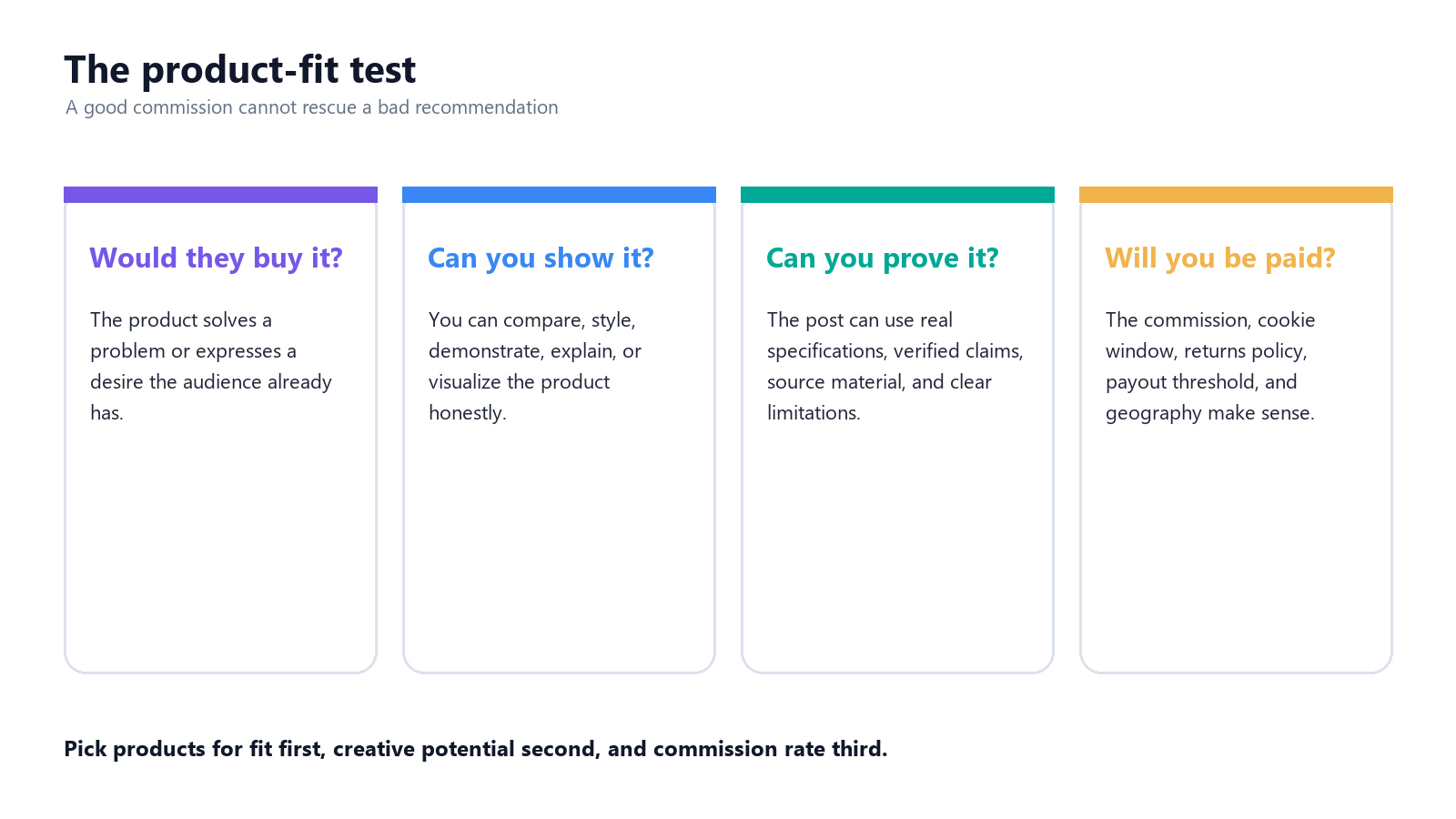
Before joining a program, ask four questions:
- Would this audience already buy it? A large commission cannot rescue a product that solves no relevant problem.
- Can the character show it clearly? Comparisons, styling, tutorials, and demonstrations make stronger posts than a floating product link.
- Can you prove the claims? Use official specifications, manuals, authorized product imagery, and verified source material.
- Will you actually be paid? Check commission, attribution window, geography, returns, payout threshold, and AI-content rules.
Where to find affiliate programs
Start with direct programs from products the account already features. Then look at creator and affiliate systems such as impact.com, Amazon Associates or Influencer, YouTube Shopping, TikTok Shop where available, LTK, ShopMy, Awin, CJ, Rakuten Advertising, and retailer-specific programs. Access, commission rates, and AI-content policies change; read the current terms before committing production time.
Read these terms before saying yes
Affiliate dashboards are good at making the commission percentage look important and everything else look secondary. In practice, the unattractive fine print often decides whether a campaign makes money. Record the following in a simple program sheet before creating content:
- Commission and payout: percentage or flat bounty, minimum payout, payment schedule, currency, tax forms, and supported countries.
- Attribution: cookie window, last-click rules, app-to-web tracking, coupon attribution, and whether another publisher can overwrite your referral.
- Reversals: returns, cancellations, subscription trials, chargebacks, and the date a commission becomes final.
- Promotion restrictions: paid search, paid social, coupon sites, email, direct linking, trademark bidding, shortened links, and platform-specific product tags.
- Creative restrictions: whether AI-generated people, edited product imagery, virtual try-ons, synthetic voices, or altered demonstrations are permitted.
- Asset rights: which product images, logos, descriptions, and videos you may reuse—and where.
Save a dated copy or screenshot of the terms you relied on. Networks and retailers update conditions; a lightweight record prevents confusion when a campaign is reviewed months later.
Affiliate formats people actually watch
| Format | Hook | What makes it useful |
|---|---|---|
| Comparison | “Which one is actually worth it?” | Use the same criteria for each option and name the loser honestly. |
| Problem / solution | “This fixes the annoying part of…” | Show the problem before introducing the product. |
| Virtual try-on | “Three ways to wear this under $80” | Preserve garment details and label the visualization as AI. |
| Product demo | “Here is what this feature really does” | Use verified functions; never invent hands-on experience. |
| Roundup | “Five picks for a tiny desk” | Curate around a specific use case, not a random shopping list. |
| Tutorial | “How to get this result using…” | Teach enough to be useful even if the viewer does not purchase. |
Disclose without making the caption unreadable
The commercial relationship and the synthetic visualization should both be clear where people will actually see them. A normal disclosure might say: “Affiliate link—I may earn a commission. The outfit shown is an AI visualization; product details and sizing come from the retailer.”
Do not hide the disclosure in a profile, after a wall of hashtags, or behind “more.” Platform labels help, but they do not replace a clear disclosure in the endorsement itself.
Virtual clothing and AI product demos
Modern image and video models are dramatically better at keeping a character recognizable while changing wardrobe, holding products, preserving references, and creating multi-shot campaign scenes. That gives an AI creator a real production advantage—but only when the product remains truthful.
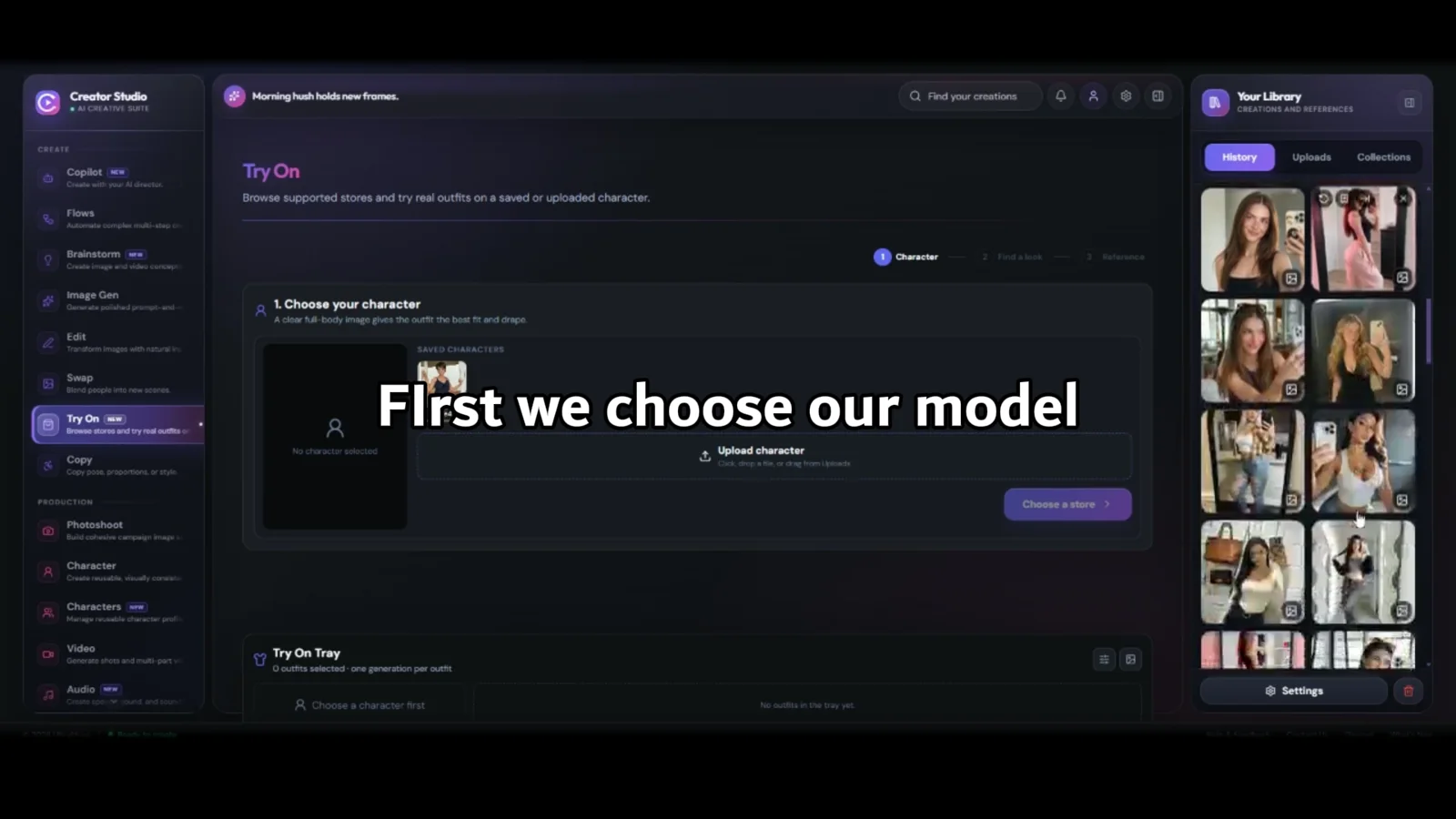
A responsible virtual try-on workflow
Save the authorized product image, description, material, colour, pattern, and size information.
Place the garment on the approved AI character without changing construction, branding, or key proportions.
Compare seams, colour, pattern, length, closures, logo, and accessories against the source.
Animate only the approved still, then label it as a visualization and link to the real retailer listing.
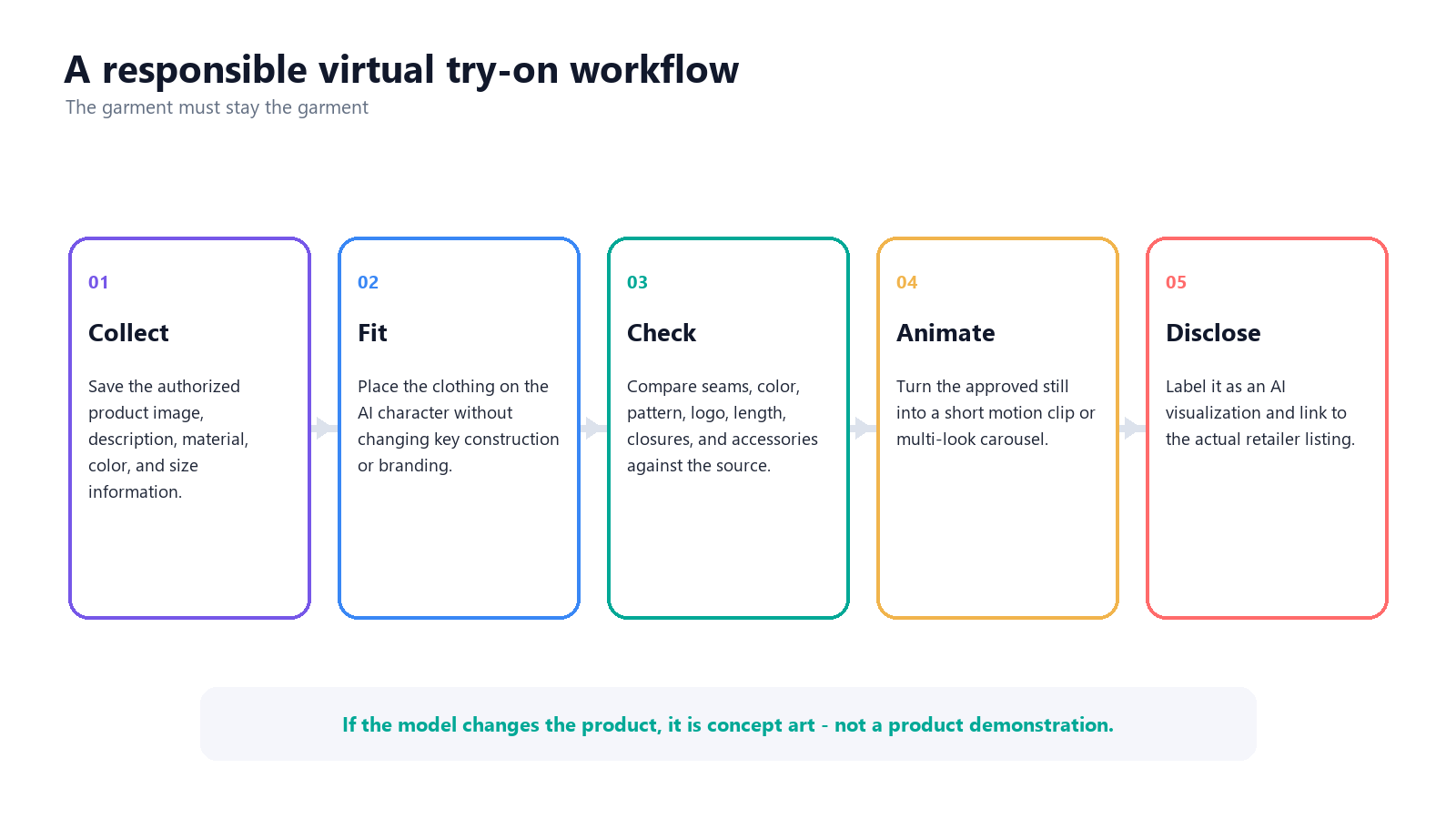
If the model changes the product, you have concept art—not a product demonstration. Do not present it as evidence of fit, performance, texture, taste, durability, or results.
Where Creator Studio fits
Creator Studio keeps the character, Try On, UGC Creator, Photoshoot, image generation, editing, swap, copy, video, motion control, captions, asset library, and publishing in one connected workflow. The advantage is not merely making one attractive image. It is keeping the same person, product, disclosure, source material, and campaign idea consistent across a complete week of content.
Useful specialist alternatives include ChatGPT Images or Gemini for guided image editing, Stable Diffusion or FLUX workflows for local control, Google Doppl or retailer try-on tools for apparel, and Runway, Kling, Veo, Wan, or Adobe Firefly for video. The trade-off is more exporting, version management, licensing review, and manual quality control.
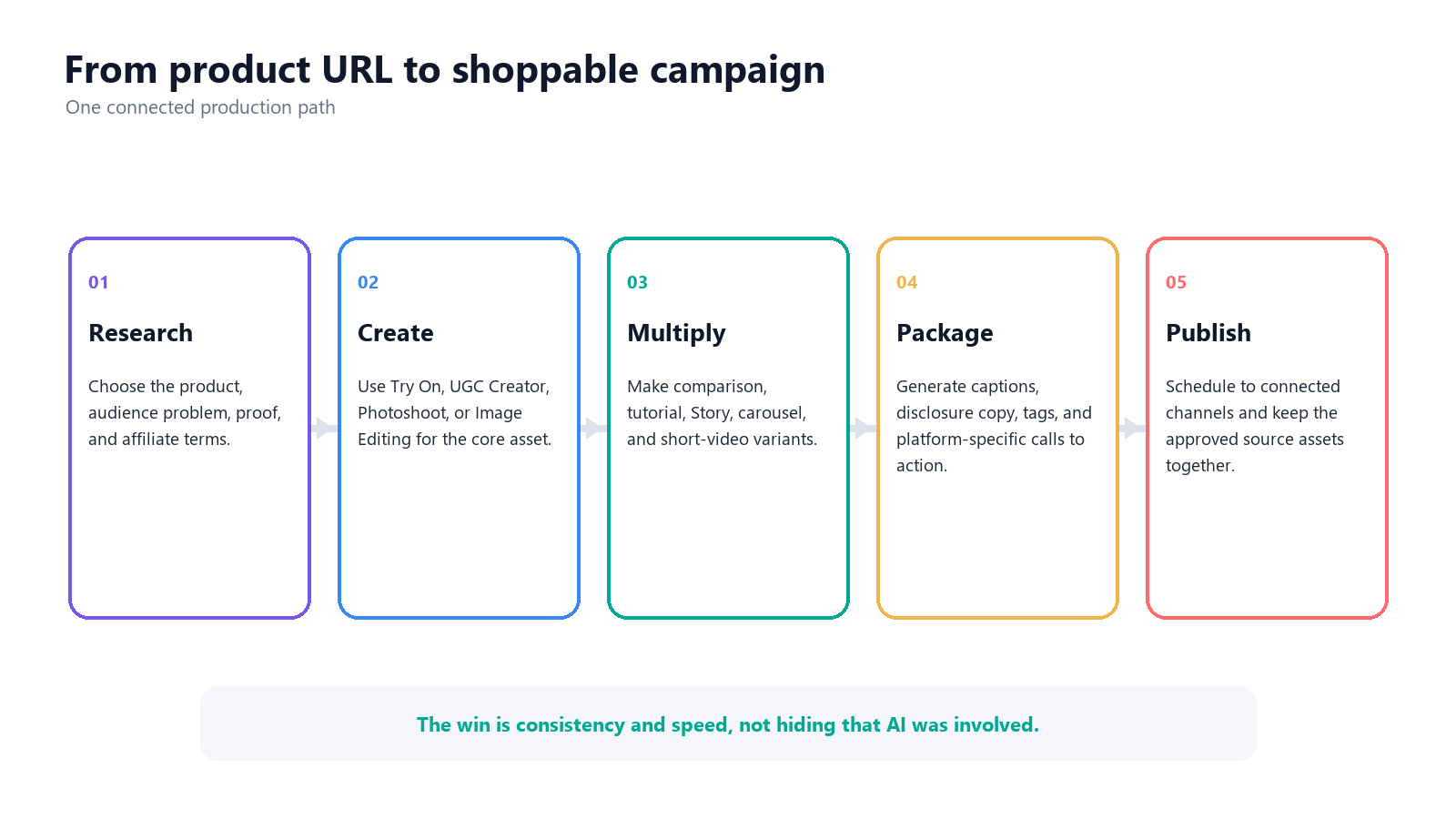
A repeatable product-to-post workflow
- Research: collect the official product URL, claims, specifications, authorized imagery, affiliate terms, audience objections, and three competing options.
- Choose one useful angle: comparison, use-case tutorial, outfit formula, problem/solution, buyer checklist, or an honest “who should skip this?” post.
- Create the approved first frame: lock the character, product appearance, setting, disclosure, and visual hierarchy before generating variations.
- Multiply deliberately: make platform ratios, hook variants, a still, a carousel, a short video, and a landing-page image from the same approved idea.
- Package: prepare the caption, affiliate disclosure, AI label, product tag, alt text, link parameters, source log, and a clear next action.
- Publish and learn: compare watch time, saves, profile visits, product clicks, orders, returns, and net commission with the creative angle used.
The shortcut is not “generate more.” It is approving one truthful campaign idea and reusing it without losing the product details or character identity.
Know the numbers without living in a spreadsheet
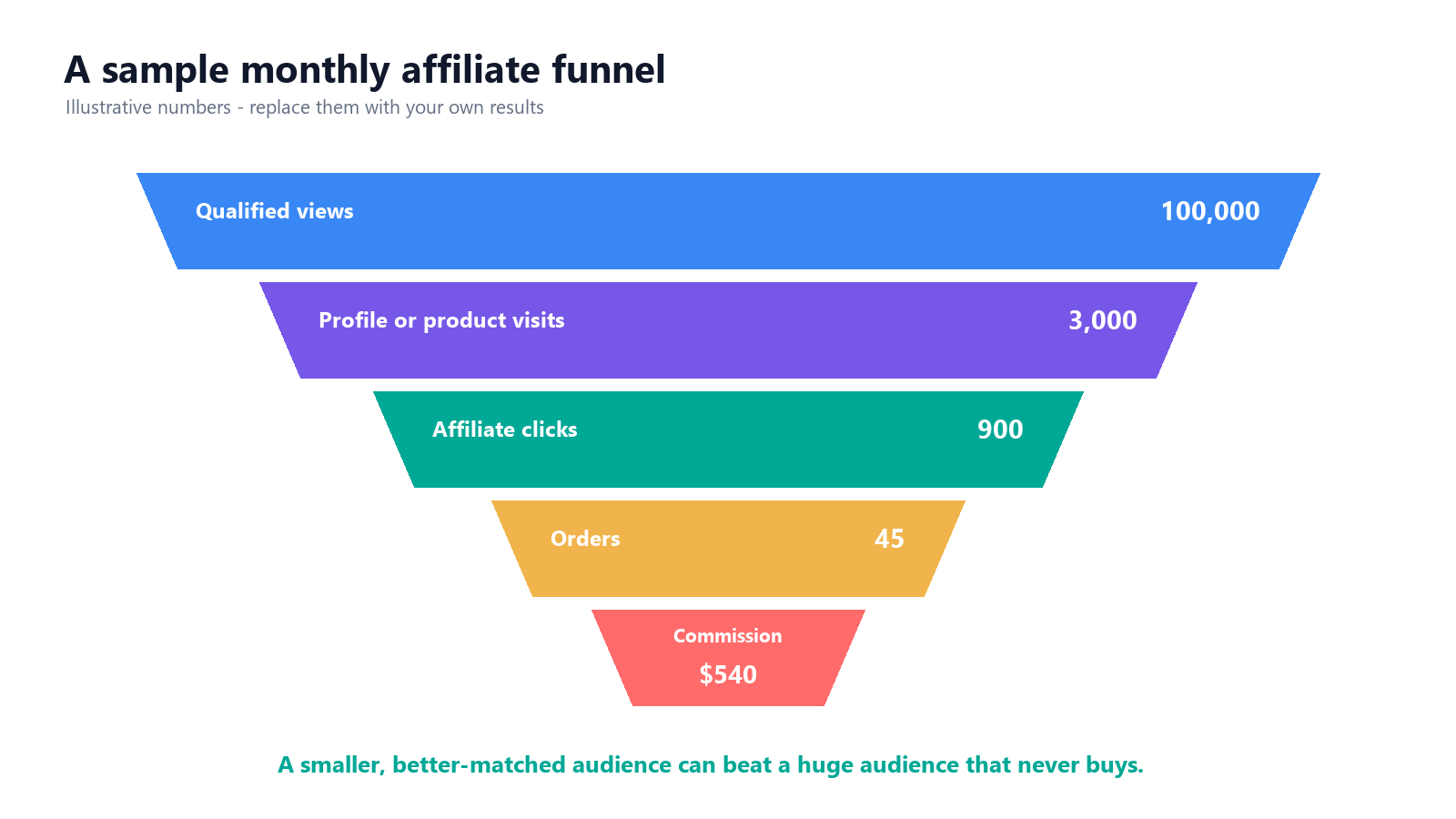
Track the funnel from qualified attention to net commission:
Do viewers care enough to inspect the product?
Does the retailer’s page finish the sale?
What is a conversion actually worth after returns?
Which content makes attention economically useful?
The fifth number: reversal rate
Returns and cancelled subscriptions can quietly erase the apparent winner. Track reversed commissions as a percentage of initially reported commission. A post that produces fewer orders but almost no reversals may be more valuable than a high-pressure post that attracts poor-fit buyers. Keep gross orders, approved orders, and net paid commission separate.
Tag links by format and angle, not just by platform. “Instagram” tells you where a sale came from; “Instagram / small-desk comparison / version B” tells you what to make next.
Low clicks usually signal a weak product fit, creative angle, or call to action. Healthy clicks with no sales often mean the offer, landing page, price, geography, or audience intent is wrong. Diagnose the stage before simply posting more.
Brand deals: how to become easy to hire
Brands do not buy follower count alone. They buy creative production, access to a relevant audience, permission to run the creative as advertising, or some combination of the three. AI creators can be particularly useful when they offer rapid variations, controlled art direction, localization, and a recognizable character.
Build proof before asking for money
- Make three unpaid spec concepts for products that genuinely fit the account. Label them as unsolicited concepts, not official partnerships.
- Show several formats: organic short-form, product still, carousel, script, and an ad-ready variation.
- Track watch time, saves, useful comments, profile visits, clicks, and attributable sales.
- Create a one-page media kit with the character, audience, strongest results, services, process, and contact details.
- Keep a portfolio link that loads quickly and works on a phone.
Where deals come from
Inbound: put a business email in the bio, keep the niche obvious, and maintain a clean portfolio. Brands need to understand the fit in seconds.
Marketplaces: Instagram’s creator marketplace, TikTok One, impact.com/creator, YouTube opportunities, and specialist marketplaces can surface briefs. Requirements vary, so do not wait for a marketplace to build the business.
Direct outreach: contact an influencer marketing manager, social lead, paid-social manager, affiliate manager, or a smaller brand’s founder. Lead with an observation and a concept—not your life story.
A pitch you can adapt: “Hi Maya—I run Nori, a disclosed virtual creator for small-space beauty routines. Your refill launch fits a series our viewers already save: one shelf, one week. I mocked up a 20-second concept showing the refill process and three still variants. I can produce the asset for your channels, post it to our audience, or package both with 30-day paid usage. Portfolio: [link]. Want the one-page concept?”
Follow up without becoming annoying
- Follow up once after three to five business days and add something useful: a cleaner hook, a seasonal angle, or a one-frame mockup.
- Send a final short follow-up roughly a week later with a clean yes/no close. Make it easy to decline.
- If there is no reply, move the idea to a different suitable product. Never imply a partnership that did not happen.
- Keep a contact log so the same person does not receive disconnected pitches from several accounts.
- When a brand says “not now,” ask whether timing, budget, fit, or rights caused the hesitation. The answer improves the next pitch.
A small AI creator can win work without a huge following by being unusually easy to brief: clear deliverables, predictable revisions, fast variations, organized rights, and a character that stays visually consistent.
Price the deal in pieces
| Line item | What it covers | Ask before quoting |
|---|---|---|
| Creative production | Concept, script, generation, editing, sound, project management | How many concepts, assets, ratios, and revisions? |
| Organic posting | Access to your account and audience | Which platforms, dates, links, tags, and approval deadlines? |
| Paid usage | Permission to run the content as an ad | Where, for how long, with what spend and edit rights? |
| Exclusivity | You avoid specified competitors | Exact competitors, category, geography, and duration? |
| Character rights | Use of the virtual persona, likeness, format, or voice | Campaign-only use or broader licensing? |
A useful quote is: production fee + organic posting fee + paid-usage fee + exclusivity + optional variants or source files. Keep rights-heavy items visible. “One video” should never quietly include unlimited advertising, raw files, perpetual character rights, and exclusivity.
Contract points creators regret skipping
- Exact deliverables, aspect ratios, duration, due dates, revision limit, approval window, and who supplies product claims or source assets.
- Payment amount, deposit, payment deadline, late terms, cancellation or kill fee, and expenses.
- Usage channels, territory, term, paid-media permission, editing, whitelisting, sublicensing, and renewal price.
- Exclusivity category, named competitors, geography, and duration. “Beauty” is much broader than “refillable facial cleanser.”
- Ownership of the virtual character, voice, likeness, prompts, training files, raw assets, and whether the brand may train another model on your work.
- Who is responsible when the brand supplies a false claim, unlicensed song, logo, photo, or other unsafe input.
Separate production from rights. The time required to make an asset and the value of allowing a brand to run it for a year are different things.
How to deliver brand-ready AI content
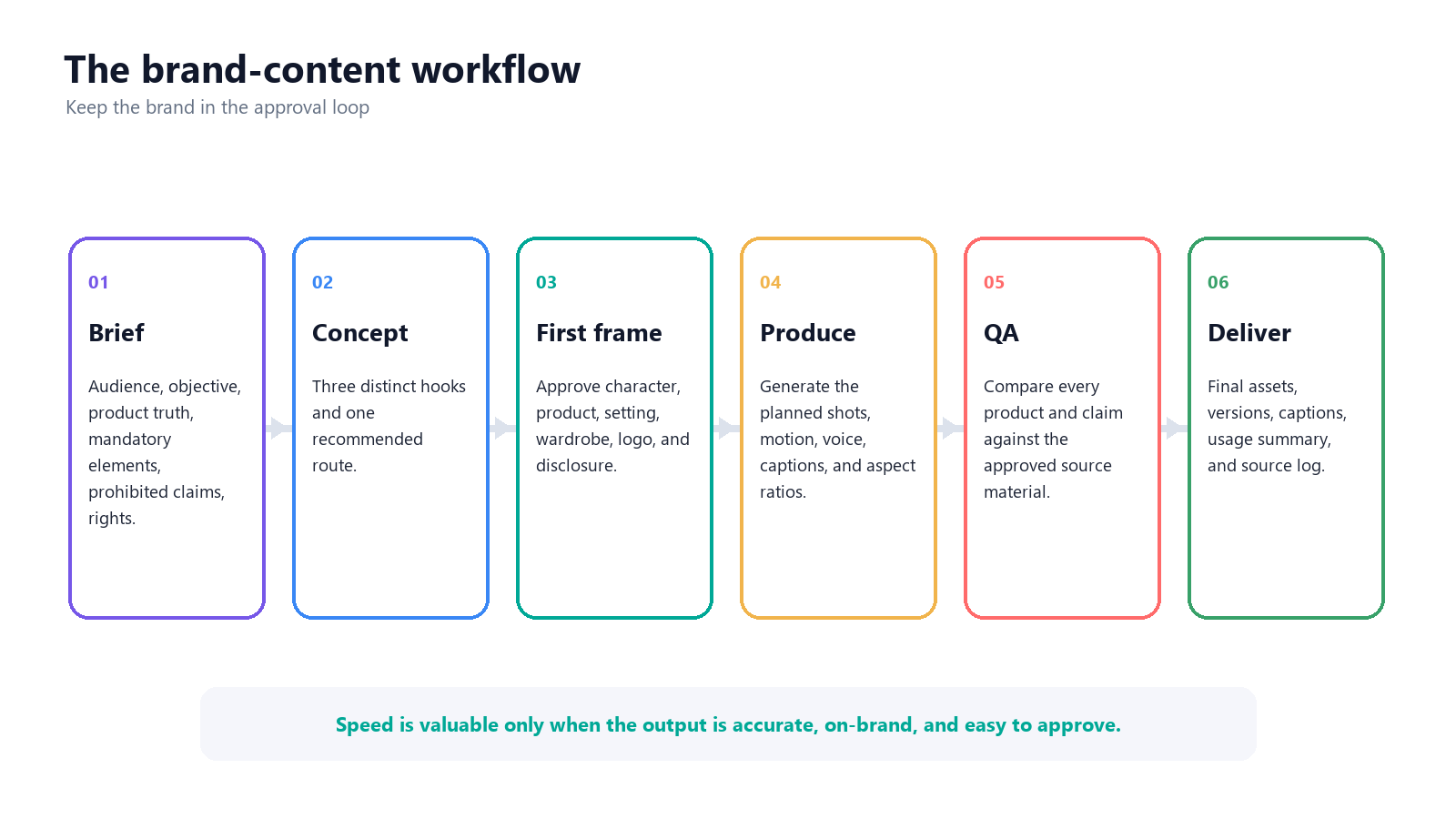
Start with a written brief containing the audience, objective, product truth, mandatory elements, prohibited claims, deliverables, platform, deadline, and rights. Present several genuinely different concepts rather than three visual variations of the same hook. Once the brand chooses a route, approve a representative first frame before rendering the full campaign.
Quality assurance should compare the product, logo, packaging, colour, controls, garment construction, spoken claims, captions, and disclosures against the approved source. Deliver final files with clear names, platform ratios, captions, alt text, usage summary, disclosure language, and a source log. The professional advantage is not that AI makes revisions effortless; it is that your system prevents unnecessary revisions in the first place.
Other income streams worth knowing
Affiliate income and brand deals are the focus, but they become stronger beside a few complementary offers:
- Digital products: presets, prompt packs, templates, checklists, and mini-guides built from repeated audience questions.
- Membership: behind-the-scenes builds, early access, live creation, and asset drops.
- Services: UGC production, campaign concepts, and AI-character setup for brands.
- Licensing: the character, visual world, format, or voice when the intellectual property is distinctive and documented.
- Commerce: curated storefronts, merch, or print-on-demand once the character has real taste and identity.
Disclosure, copyright, and trust
A virtual character can be entertaining without pretending to be a real customer. Use three layers of disclosure: identify the profile as virtual, use platform AI or altered-content labels when required, and disclose every commercial relationship clearly in the sponsored or affiliate post.
An AI character cannot truthfully say, “I used this for three months and it fixed my skin,” if nobody had that experience. It can explain verified features, demonstrate a visualization, compare documented specifications, or present a clearly fictional scenario.
Keep human-authored scripts, selections, edits, layouts, prompts, source material, and approval records. Get permission for every real face, voice, logo, photo, product image, and commercial asset you use.
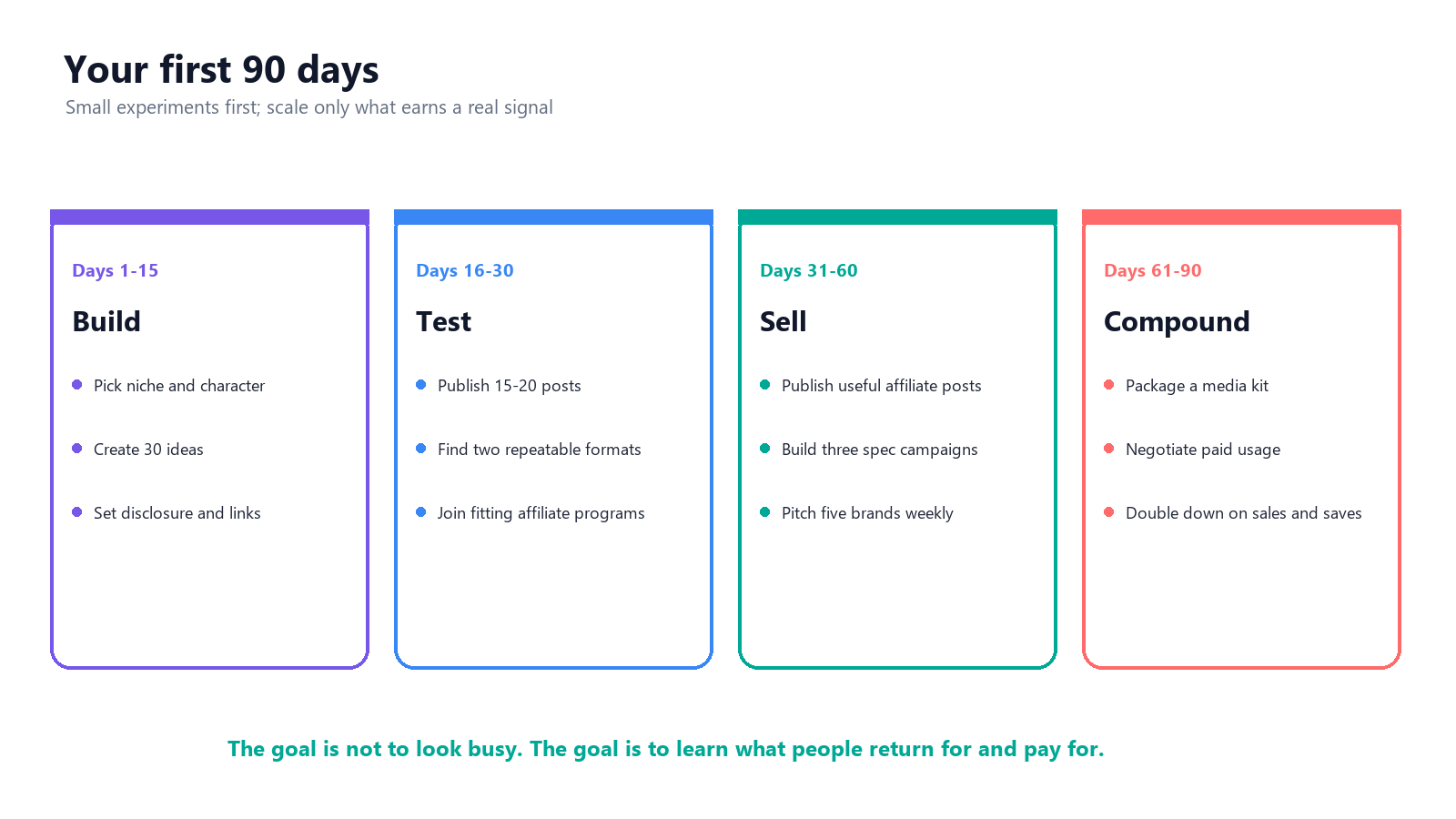
Your first 90 days
Choose the niche and character, create 30 ideas, set disclosure language, and organize source assets.
Publish 15–20 posts, find two repeatable formats, and join fitting affiliate programs.
Publish useful affiliate posts, build three spec campaigns, and send five tailored brand pitches each week.
Package a media kit, negotiate paid usage, double down on clicks and sales, and archive the winning workflow.
Your weekly minimum once the account is running
- Publish four to seven strong pieces, depending on the complexity of the format.
- Reply to real questions and turn at least two useful questions into future posts.
- Test one affiliate angle and review clicks, approved orders, reversals, and net commission.
- Send five specific brand pitches or marketplace applications with a relevant concept.
- Archive the winning prompt, reference assets, product claims, approvals, disclosure, caption, link tag, and final version.
Two repeatable content formats, a recognizable character, measurable product clicks or sales, three portfolio-quality brand concepts, and a production process you can repeat without chaos.